
As your association grows, so does the financial work behind it. Budgets get more complex, revenue streams multiply, and your board expects clearer answers about where your organization is headed. Often, that responsibility lands on the executive director.
A bookkeeper may record day-to-day transactions, but the executive director is left scrambling to build the budget, explain variances to the finance committee, field the treasurer’s questions, and plan for reserves. That arrangement can work for a while, until conference revenue comes in below projections, or the board starts asking for forecasts no one has time to build.
A fractional CFO for associations fills that gap. This part-time financial executive provides senior-level strategy, without the cost of a full-time hire.
To help you decide whether a fractional CFO is right for your organization, we’ll walk you through the fundamentals that apply to any nonprofit, plus what membership-based organizations need specifically:
- What is a fractional CFO?
- What services does a fractional CFO provide for nonprofits?
- Benefits of Hiring a Fractional CFO for Your Association
- Why Associations Need Association-Specific CFO Expertise
- Signs Your Association Is Ready for a Fractional CFO
- How to Choose a Fractional CFO for Your Association
- Fractional CFO for Associations: FAQs

What is a fractional CFO?
A fractional CFO is an experienced chief financial officer who works with your organization part-time or on a contract basis. Instead of hiring a full-time executive, you get senior-level financial strategy, planning, and board guidance for a set number of hours or a defined scope of work.
What services does a fractional CFO provide for nonprofits?
A fractional CFO for nonprofits leads the strategic side of financial management. They build and monitor budgets, forecast cash flow, translate financial statements for the board, strengthen internal controls, prepare your organization for audits, and connect financial decisions to your mission and long-term strategic plan.
Every engagement looks a little different, but most fractional CFOs cover these core responsibilities:
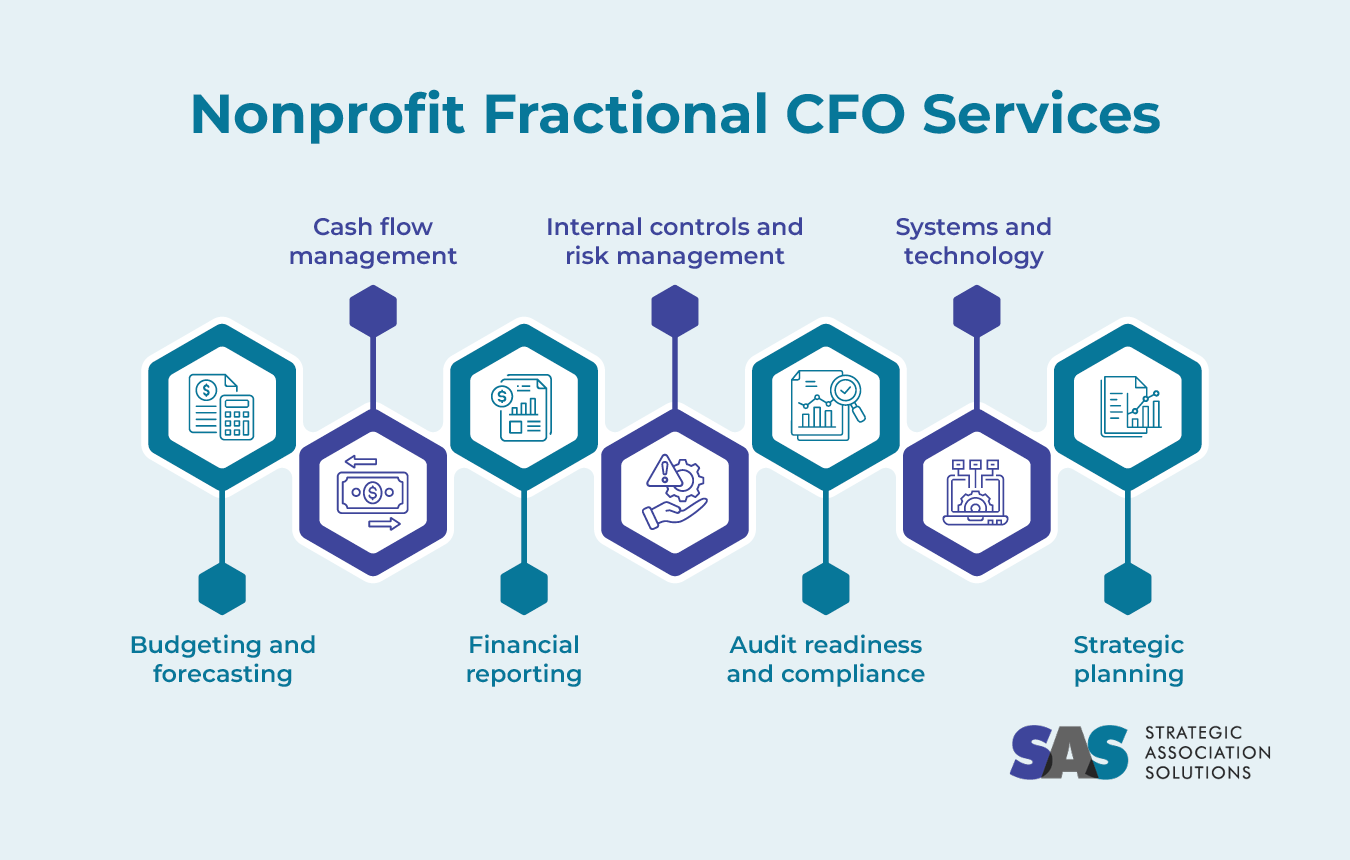
- Budgeting and forecasting. Your fractional CFO leads the annual operating budget alongside leadership and the finance committee. They also run monthly budget-to-actual reviews, so you can spot variances early and adjust forecasts during the year. Many also build scenario models that show how your budget would hold up under best-case, worst-case, and most-likely conditions.
- Cash flow management. Month-by-month cash projections show when money will come in and go out, so leadership can plan around slower periods instead of reacting to them.
- Financial reporting for the board. A fractional CFO turns financial statements into clear dashboards and explains what the numbers mean for your organization’s direction. They often attend board and finance committee meetings to present results and answer questions.
- Internal controls and risk management. Your fractional CFO develops financial policies, separates financial duties, and identifies vulnerabilities before they become problems.
- Audit readiness and compliance. Organized records and documentation help audits and annual filings, such as Form 990, run more smoothly, and your fractional CFO can assist with this process.
- Systems and technology. As your organization grows, your fractional CFO can advise on accounting software, help you set it up, and connect it with the rest of your tech stack.
- Strategic planning. Fractional CFOs translate your strategic plan into financial terms, setting multi-year financial goals and identifying the resources needed to reach them. This work ties into your broader association strategy and helps you weigh major decisions, like launching a program or merging with another organization.
When hiring a fractional CFO, you don’t need to hand over each of these areas at once. Start with the area that demands the most attention, which is often budgeting or board reporting, and expand the scope as you build trust with your fractional CFO.
Benefits of Hiring a Fractional CFO for Your Association
Hiring a fractional CFO provides your association with senior financial leadership at a fraction of the cost of a full-time executive. You gain specialized expertise, flexible support that scales with your needs, more accurate reporting, and more time for your executive director to focus on members and mission.
Here’s what your association stands to gain:
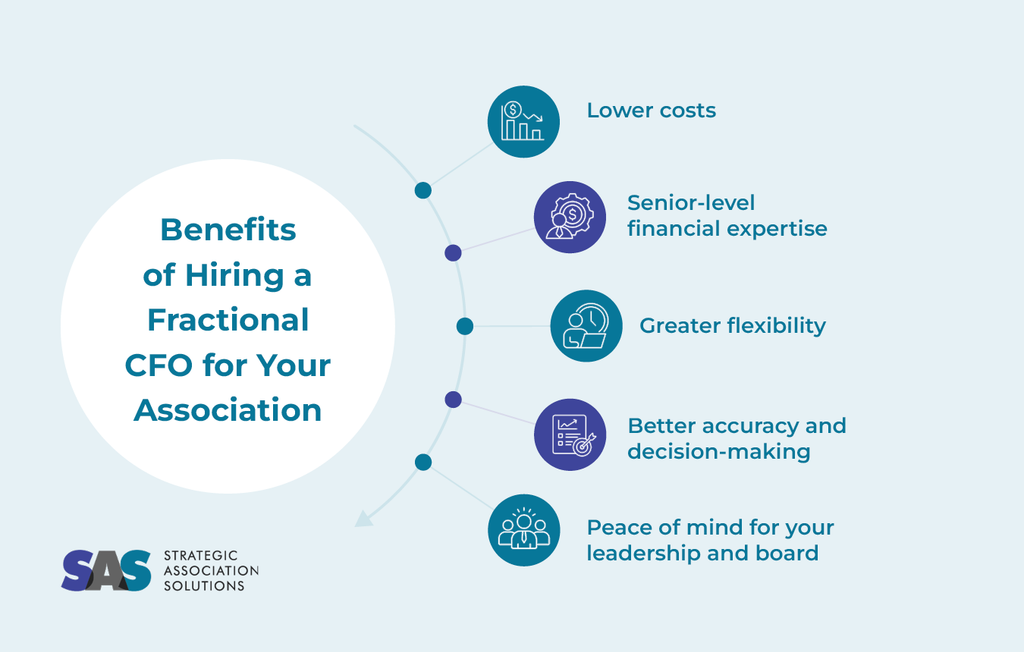
- Lower costs. Hiring a fractional CFO allows you to avoid the expenses associated with recruiting, onboarding, and paying salary and benefits for a full-time executive. Instead, you pay only for the expertise you need, saving money you can allocate to other areas.
- Senior-level financial expertise. A fractional CFO brings years of experience in financial planning, analysis, and risk management. That expertise helps your association interpret its numbers accurately, spot trends and warning signs early, and make major decisions with a clear understanding of their financial impact.
- Greater flexibility. You can scale support from a fractional CFO up during budget season, an audit, or a major initiative, for example, then back down once the work is done.
- Better accuracy and decision-making. With professional oversight, your board receives reports it can trust. Your forecasts also become tools for real decisions instead of best guesses.
- Peace of mind for your leadership and board. Your executive director can stop serving as the stand-in CFO and refocus on members. Meanwhile, volunteer board members gain confidence that qualified professionals are monitoring financial risk, which also makes the investment easier to present to your board.
These benefits reflect the broader case for outsourcing your association’s back-office functions: you gain expert support without the overhead of building it in-house.
Why Associations Need Association-Specific CFO Expertise
Associations run on a different financial model than most charities. Recurring membership dues, event and sponsorship revenue, tax rules for 501(c)(6) organizations, and volunteer treasurers who change every year all add complexity. A fractional CFO for associations understands these dynamics and plans around them from day one.
Most fractional CFO guidance assumes grants and donor restrictions are the biggest complexity. That’s rarely true for associations. Dues, events, and sponsorships drive your budget instead, and each brings its own challenges:
- Membership dues and deferred revenue. Members often pay dues upfront, but you recognize that revenue over the membership term. A generalist fractional CFO may not account for how renewal cycles shape your cash position. A provider that works with associations already knows how to forecast renewals and lapsed memberships, so your projections reflect when your revenue arrives.
- Non-dues revenue swings. Annual conferences, sponsorships, certification programs, and continuing education can make up a large share of your revenue. That money rarely arrives evenly. A provider experienced with associations has managed these cycles before and can build forecasts and contingency plans around your event calendar from the start, rather than learning your revenue patterns over several budget cycles.
- Tax and compliance considerations. Many trade associations are tax-exempt under Section 501(c)(6). If they lobby, they generally must tell members what portion of their dues isn’t deductible or pay a proxy tax instead. Associations that sell advertising may also owe unrelated business income tax (UBIT). These requirements rarely apply to charities. A CFO without association experience may not know to look for them, while an association-specific provider builds them into your compliance calendar and budget from day one.
- Reserves and long-term stability. A strong reserve policy helps your association weather a weak conference year or an economic downturn without cutting member programs. A provider who works with associations understands how heavily your budget depends on events and renewals, so they can recommend reserve targets that match your actual risk.
- Chapters and multi-department reporting. Chapter accounts and separate budgets for membership, events, advocacy, and education complicate consolidated reporting. An association-specific provider has built these reporting structures before and can roll everything up into a clear picture for your board.
- Board and treasurer turnover. Officer handovers make consistency difficult year after year. An association-specific fractional CFO understands volunteer governance and knows how to bring each new treasurer up to speed quickly, providing the continuity a rotating board can’t.
Before you bring on a fractional CFO, map your revenue by month for the past two or three years. Seeing exactly when dues, sponsorships, and event income arrive gives your new partner a head start and often reveals cash flow pressure points.
Signs Your Association Is Ready for a Fractional CFO
Your association is likely ready for a fractional CFO when financial management is pulling your executive director away from members, the board needs more detailed financial insight than your team can provide, or growth, a merger, or a major investment is approaching without a clear financial plan.
Common indicators include:
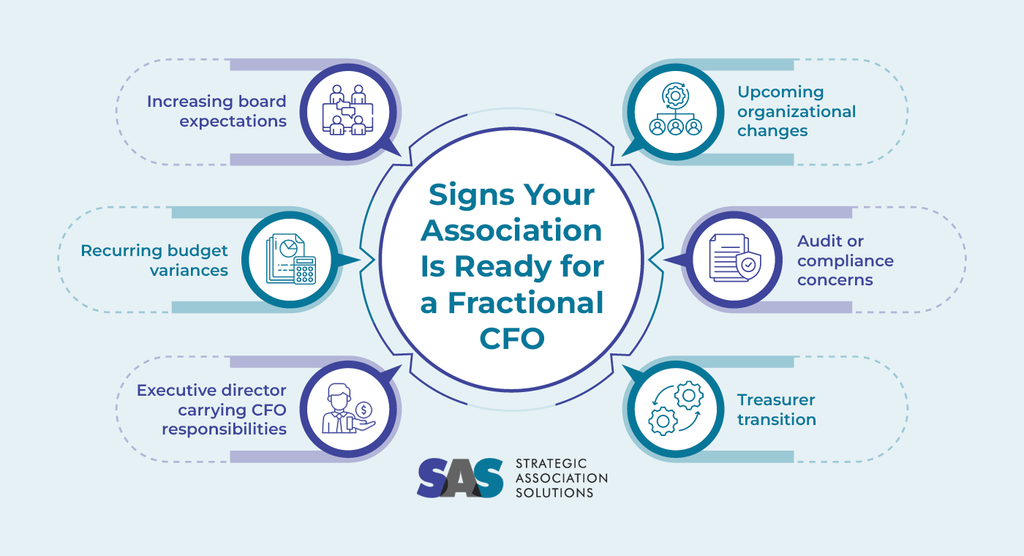
- Executive director carrying CFO responsibilities. Budget development, variance analysis, and board financial reporting fall to the executive director, limiting their time available for members and programs. A fractional CFO takes on that strategic workload, so your executive director can review financial plans rather than build them.
- Recurring budget variances. Conference revenue, sponsorships, or renewals regularly fall short of projections without early warning. When the same gaps appear year after year, your forecasting process likely needs more rigor than your current team can provide.
- Increasing board expectations. Perhaps your finance committee requests forecasts, scenario analyses, or a formal reserve policy that your current team lacks the capacity to produce. A fractional CFO can deliver these materials and present them directly to the board.
- Upcoming organizational changes. A merger, a new association management system (AMS), a new program line, or a relocation will significantly affect your finances. Bringing in financial leadership before these changes take effect helps you model costs and avoid surprises during the transition.
- Audit or compliance concerns. Let’s say a recent audit identified internal control weaknesses, or your team is uncertain whether your association is meeting its tax obligations. Left unaddressed, these issues can expose the board to risk and erode member trust, but a fractional CFO can step in to help resolve them.
- Treasurer transition. An incoming treasurer requires continuity and professional support to oversee the association’s finances effectively. A fractional CFO can brief new officers on the association’s financial position and keep long-term plans on track through each handover.
If several of these indicators apply, begin by documenting the time your executive director spends on financial tasks each month. That figure provides a concrete starting point for evaluating outside support with your board.
How to Choose a Fractional CFO for Your Association
Choose a fractional CFO with direct experience in membership-based organizations, a clear scope of work, transparent pricing, and reliable accounting support behind them. The right partner should communicate comfortably with your board and understand the systems, revenue streams, and compliance requirements specific to associations.
Many firms offer nonprofit fractional CFO services, and their experience varies widely. As you evaluate your options, ask these questions:
- Association experience: Have they worked with trade associations or professional societies similar in size to yours?
- Defined scope and communication: What’s included, how often will you meet, and who is your day-to-day contact?
- Board-ready communication: Can they present clearly to a finance committee of volunteers?
- Technology fluency: Do they know your AMS and accounting platforms, and can they help those systems share data?
- Pricing transparency: Is the engagement a flat monthly fee, hourly, or project-based? What would trigger a change in cost?
Before you sign, ask for a reference from an association similar to yours. A short call with a peer executive director will tell you more about day-to-day communication than any proposal.
Fractional CFO for Associations: FAQs
How much does a fractional CFO cost?
The cost of a fractional CFO depends on the scope of work, the number of hours involved, your association’s financial complexity, and whether accounting services are included. Engagements are typically structured as a monthly retainer, an hourly rate, or a project fee, so request a detailed proposal from each provider you consider.
How many hours does a fractional CFO work?
A fractional CFO’s hours depend on the scope you agree on. Many engagements follow a recurring monthly schedule, with more time during budget season, audits, or major initiatives and less during steady periods.
How is a fractional CFO different from a bookkeeper or controller?
A bookkeeper records daily transactions, a controller oversees accounting operations and financial statements, and a fractional CFO uses that financial data to guide strategy, budgeting, and forecasting. A fractional CFO also differs from your treasurer, who provides volunteer oversight, and from an interim CFO, who temporarily fills a full-time vacancy.
Should we hire a fractional CFO or a full-time CFO?
Most small and mid-sized associations are well served by a fractional CFO, who provides strategic guidance without the cost of a full-time executive. A full-time CFO makes more sense for large associations that need daily, in-house financial oversight and a leader to build out an entire finance department.
Can a fractional CFO help with audit preparation?
Yes. A fractional CFO can organize your financial records and documentation, strengthen internal controls, and serve as a point of contact for your auditors. They can also help you address any findings once the audit is complete.
Can a fractional CFO work remotely?
Yes. Many fractional CFOs work remotely, using cloud-based accounting systems and video meetings to stay connected with your team. They can also attend key board or finance committee meetings in person when needed.
Partner With SAS for Strategic Financial Leadership
A fractional CFO gives your association the strategic financial leadership it needs without a full-time executive salary. Pairing that expertise with dependable accounting means your board receives accurate reports and your team gains a clear plan for growth.
At Strategic Association Solutions (SAS), we focus exclusively on membership-based organizations like trade associations and professional societies. Our accounting and bookkeeping services keep your financial records accurate and up to date. Our advisory and strategy services add the financial health analysis, strategic planning, and risk management support a fractional CFO provides. Because one team handles both, your financial strategy builds on books we already know.
If your executive director is still serving as your association’s CFO, the next step is a conversation. Fill out our contact form to discuss how SAS can support your association’s financial strategy, or explore our full range of back-office solutions.
To learn more, check out these additional resources:
- Accounting for Associations: The Basics and Expert Tips. Learn the fundamentals of association financial statements, tax forms, and budgeting.
- How to Build an Association Strategy That Fuels Growth. Explore how to develop a strategic plan that aligns your finances, operations, and member experience with your mission.
- Audit Readiness for Membership-Based Associations: A Strategic Imperative, Not a Year-End Exercise. Discover why year-round audit preparation strengthens your association’s financial health and board confidence.


Effie Panos
Principal
As a self-starter and team player, Effie brings a blend of management and extensive accounting experience, with expertise in financial management, Generally Accepted Accounting Principles (GAAP), operations, change management, budgeting, forecasting, and revenue optimization to clients.
Effie holds a Bachelor of Science in Accounting from the University of Illinois. She has held many previous roles in nonprofit accounting and operations, most recently as a Controller for A Safe Haven Foundation and Vice President of the Not-for-Profit Division at Quattro Business Support Services.