
Your association’s website is the epicenter for organizational information and member engagement. It’s an online hub for current and prospective members alike to learn everything there is to know about your association, register for events, renew memberships, and so much more.
However, the average bounce rate for nonprofit websites is around 60-70%—much higher than the overall average of 40%. This alarming statistic means you need to make a conscious effort to update and enhance your website, ensuring it provides the best possible experience that keeps visitors around.
In this guide, we’ll review the basics of websites for associations and feature standout examples you can use for inspiration:
- What are the key elements of association website design?
- Top 7 Websites for Associations
- 6 Tips to Improve Your Association’s Website

What are the key elements of association website design?
While each association’s website might look a bit different based on its own branding and messaging guidelines, all association websites should feature the same essential elements. Whether you’re building your association website from scratch or are looking to update your current site, use the following as a checklist to ensure you’ve included all necessary components:
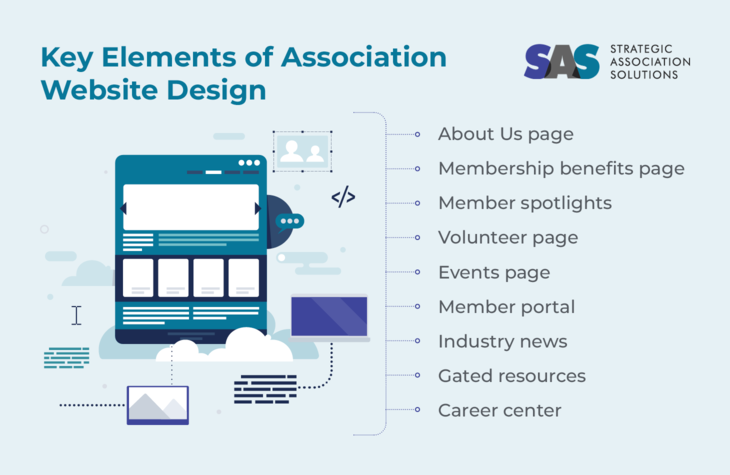
- About Us page. While your association’s homepage should start to introduce what your organization is all about, a separate About Us page allows you to dig deeper. Here, you can explain your association’s history, mission statement, and main offerings. In addition to informing prospects about your organization, this page also signals to search engines and learning language models (LLMs) what your brand is all about, enhancing both search engine optimization (SEO) and generative engine optimization (GEO).
- Membership benefits page. Prospects want to know exactly what they’ll receive when they join your association. A membership benefits page should outline each membership tier with its associated benefits and pricing. You may also include member testimonials to build social proof and persuade prospective members to convert. The page should feature calls to action that lead to your registration page.
- Member spotlights. In addition to sprinkling social proof throughout your site, consider creating a dedicated area of your website for highlighting member testimonials and accomplishments. These spotlights not only give prospects more insight into why they should become members, but they also provide an opportunity for the members featured to share their achievements with their personal networks.
- Volunteer page. Volunteers help your association run smoothly. Create a page where you can centralize volunteer opportunities, role descriptions, and applications, so you can easily gather support.
- Events page. Your association also likely hosts many events, such as conferences, webinars, or local chapter meetings. Your events page should highlight top upcoming events and include a calendar where members can view these happenings at a glance. It should also link to event registration pages so interested members can sign up right away.
- Member portal. Connect your website to an exclusive member portal where members can sign in and review pertinent information like their renewal status, members-only events, and course recommendations. This portal might also include a member directory where members can find and network with peers based on factors like location, job title, or area of specialty.
- Industry news. Members should look to your website as a resource for the latest innovations in your specific industry. By posting industry news regularly on a dedicated area of your site, you can boost your association’s authority and keep users around.
- Gated resources. Capture leads with gated resources that provide valuable insights to current and prospective members. Your resource library may contain industry benchmarking reports, guides, white papers, past publication archives, webinar recordings, and templates.
- Career center. Inspire new connections with a career center where employers can share opportunities and job seekers can search for open roles. You may charge employers to post their job openings, powering an additional non-dues revenue stream for your association.
With all of these elements on your association’s website, you’ll provide a well-rounded hub where new, long-term, and prospective members alike can engage and learn.
Top 7 Websites for Associations
Let’s explore some exceptional examples of association websites that follow web design best practices and can provide some inspiration for your own site.
1. American Group Psychotherapy Association (AGPA)
What we love about this association website
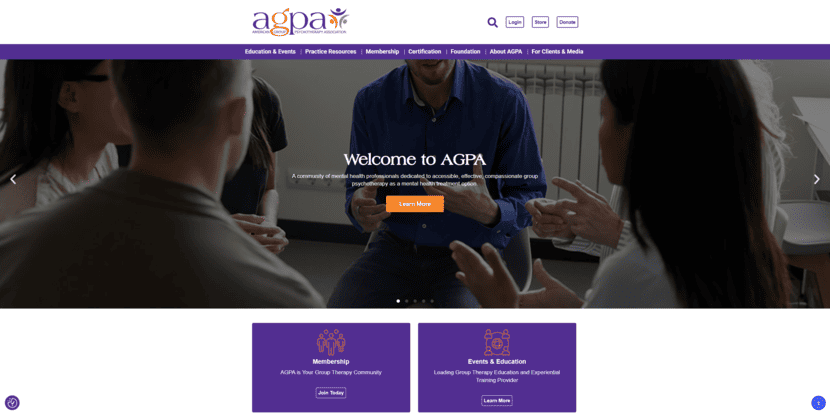
- AGPA provides distinct pathways for different users. While the Education & Events, Membership, and Certification tabs provide resources for current and prospective members, the For Clients & Media tab steers patients and members of the media in the right direction.
- This website features a “Find a Certified Group Psychotherapist” directory, which not only allows prospective patients to find certified group psychotherapists in their area but also drives referrals for the association’s members, creating another membership benefit.
- In addition to their Membership Benefits page, AGPA also has a Top 5 Reasons to Join page. This page succinctly summarizes why prospects should become AGPA members, letting them quickly understand the value of membership.
2. Pressure Sensitive Tape Council (PSTC)
What we love about this association website
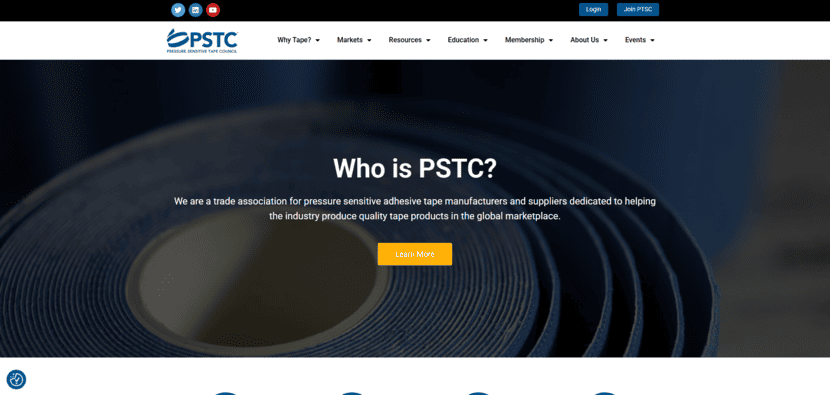
- PSTC’s Education page features Tape Academy, its very own series of live and on-demand classes covering all aspects of pressure sensitive adhesive (PSA) tape design and manufacture. This offering makes PSTC stand out as a leader in the industry and allows a variety of professionals, including manufacturers, salespeople, scientists, and engineers, to learn valuable information.
- This website also includes separate pages for different markets that allow users to learn more about PSA tape as it’s relevant to their industry. These segmented pages allow even non-members to gain value from the site and position PSTC as a source of authority on PSA tape.
- PSTC has a very clear membership page that explains the benefits of membership, different member classifications, and dues pricing. The page also features video testimonials where members explain why they joined PSTC, providing social proof.
3. Metro New York Society of Association Executives (NYSAE)
What we love about this association website
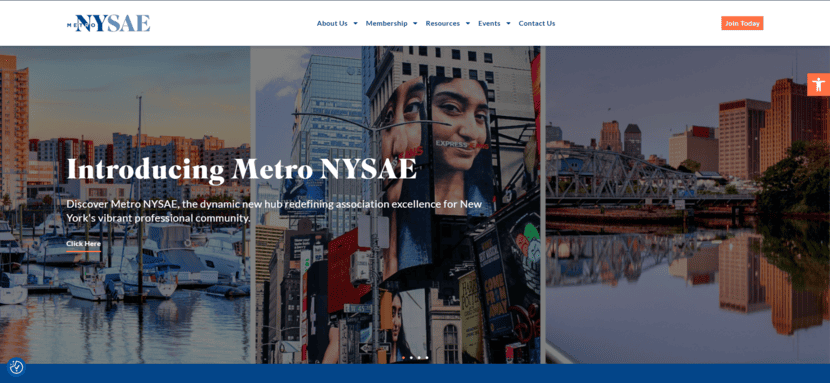
- Instead of sending users to a separate event microsite, Metro NYSAE has a page dedicated to its hallmark event, “Meet NY,” directly on the site. This comprehensive page features an event overview, hosting and sponsorship opportunities, an attendee list, attendee FAQs, and 2026 hosts, providing valuable information for everyone interested.
- Metro NYSAE’s Career Center empowers employers to post jobs, manage applications, and search resumes. It’s a powerful tool where members and non-members alike can attract top talent.
- Metro NYSAE also has a Knowledge Hub that’s frequently updated with educational content. Association leaders can easily unlock new insights, and non-members can get a taste of the high-quality content Metro NYSAE has to offer.
4. Wholesale Florist & Florist Supplier Association (WFFSA)
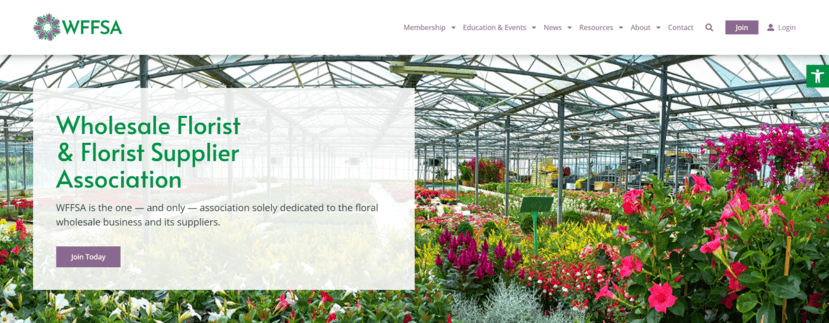
What we love about this association website
- The WFFSA features a page on The Flower Movement, a grassroots movement started by WFFSA to bring the floral community together. It focuses on storytelling, community activism, and collaboration, differentiating the organization and providing a mission-driven impetus for membership.
- WFFSA also produces an industry benchmarking survey each year, which has a dedicated page on the site. Featuring information about the report on its website shows the WFFSA is committed to furthering the industry for members and non-members alike.
- The news section of the WFFSA keeps members in the loop about upcoming events and organizational updates. In addition to signing up for the WFFSA newsletter, members can navigate to the news page to learn more.
5. American Medical Rehabilitation Providers Association (AMRPA)
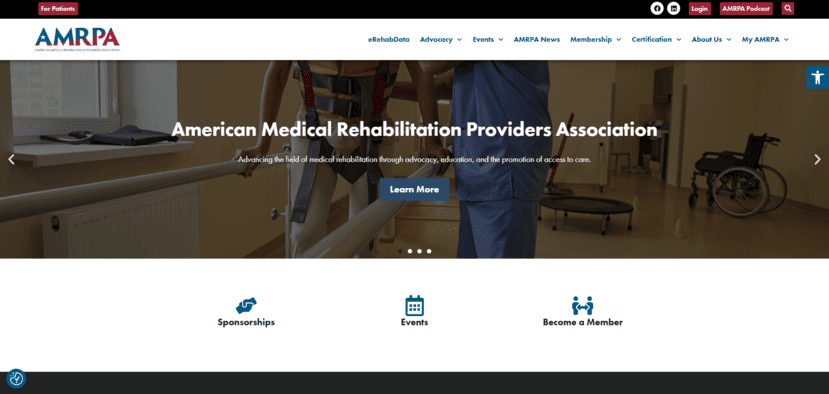
What we love about this association website
- The AMRPA website prominently features eRehabData, the association’s own patient assessment system. This offering goes beyond typical membership benefits and provides members with an indispensable tool they can incorporate into their operations.
- AMRPA clearly segments its content for two different audiences. While the main website caters to AMRPA members and prospects, the “For Patients” button takes patients to a microsite that helps them find care.
- In addition to the typical membership information, AMRPA’s website has a dedicated advocacy section. Here, members can learn more about AMRPA’s policy priorities, submit solicitation release forms, receive advocacy updates, and access the AMRPA Action Center.
6. The Association for Hose and Accessories Distribution (NAHAD)
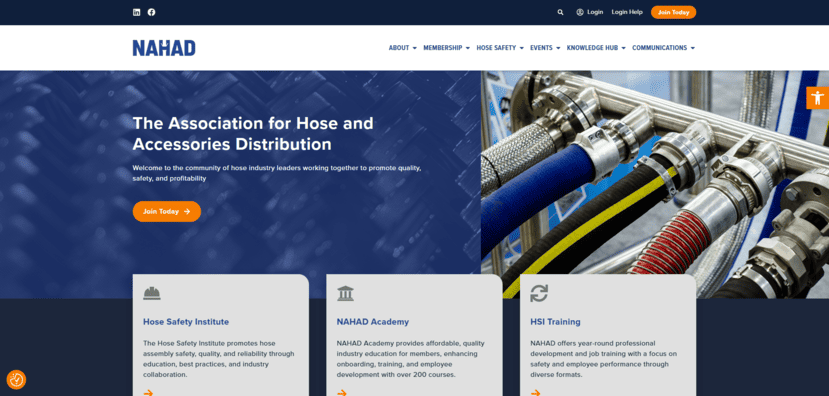
What we love about this association website
- The NAHAD website has many educational resources, including NAHAD Academy. This e-Learning program provides content to enhance members’ onboarding, training, and employee development processes, offering clear value.
- This website features an accessibility widget that lets users change the text size, font, color contrast, color scheme, and link appearance. That way, anyone can easily interpret NAHAD’s content.
- While many sites feature basic membership information, the NAHAD website goes a step further by promoting unique opportunities like LEAD, the organization’s new leadership program launching in 2026. Current members can constantly engage in new experiences promoted on the site.
7. National Association of EMS Physicians (NAEMSP)
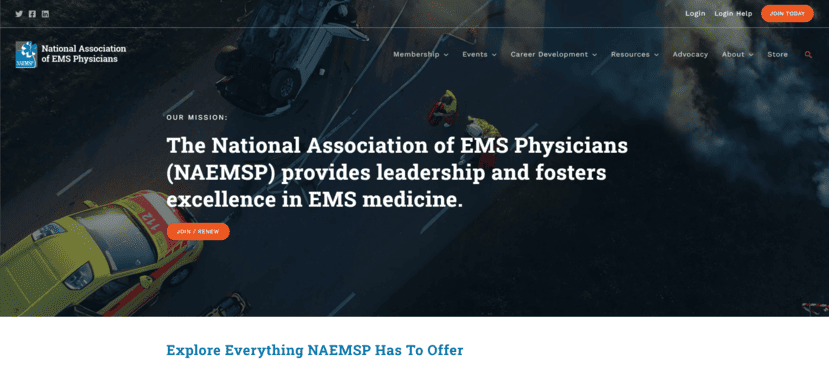
What we love about this association website
- NAEMSP has a partnership with Prodigy EMS to provide members with continuing education resources. Members can access this library right from the NAEMSP website, which prompts them to log in with their NAEMSP accounts.
- NAEMSP’s website takes educational resources to the next level with podcasts. In collaboration with other organizations, the association offers three original podcasts that members and non-members alike can listen to on the go.
- In addition to a member directory, the NAEMSP website also has a chapter directory where members and prospects can search for their state or region’s chapter and find information like the chapter’s officers, dues, bylaws, additional documents, and upcoming meetings.
6 Tips to Improve Your Association’s Website
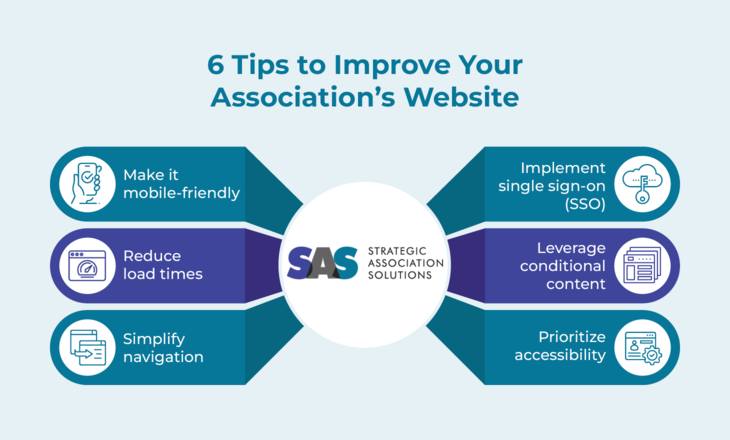
1. Make it mobile-friendly.
In 2024, 53% of all nonprofit website traffic came from mobile users—which is why your mobile website must offer them the same positive experience they would have via desktop.
Use a mobile-responsive website layout, and manually test the most critical conversion pathways on your site via a mobile device to ensure they’re easy to complete. All text should be large enough to read, and all tap targets should be large enough to touch. You may also consider running your website through a tool like SE Ranking’s Mobile Friendly Site Test to identify areas for improvement.
2. Reduce load times.
Did you know that as page load time increases from one second to three seconds, the probability of the user bouncing increases by 32%, and as it increases from one second to five seconds, the probability of bouncing jumps up to 90%?
To keep users on your site and encourage conversions, work to reduce load times by:
- Compressing images
- Implementing lazy loading
- Minifying JavaScript and CSS code
- Removing unused plugins
- Enabling browser caching
- Reducing redirects
3. Simplify navigation.
If users can’t find what they need from your association’s website quickly, they’ll likely bounce from your site. Make it as easy as possible for users to navigate your site by:
- Clearly labeling your top-level menu items. Avoid overcrowding your main menu. Instead, select your five to seven most important categories, and organize your site accordingly. Before rolling over or clicking on any item, users should know exactly what to expect. For example, the “Learn” tab may have a dropdown menu for different educational resources your association provides.
- Including a search bar. When users know exactly what they’re looking for, a search bar lets them search your entire site quickly and easily. You may further improve the search experience by enabling auto-suggest to predict users’ responses and fill them in so they don’t have to type as much information.
- Implementing breadcrumb trails. Breadcrumb trails allow users to see their current location on the site in relation to the rest of your content. For instance, this may look like Home > Resources > Webinars > Member Retention. This navigation element helps users easily navigate back to a previous page and know exactly where they are if they enter a specific page directly from search engine results.
4. Implement single sign-on (SSO).
Single sign-on (SSO) means that to unlock all of your members-only resources—such as a member portal, community platform, and LMS—members only need to log in once. That way, they can efficiently access all your association has to offer without remembering different logins and having to continuously log into different subsites.
5. Leverage conditional content.
Members are more likely to interact with your content and stay connected to your association if you personalize their experience. Conditional content changes based on members’ characteristics and history with your organization, allowing every signed-in member to receive their own unique experience.
For example, if your annual conference is quickly approaching, you may implement a conditional content block that shows a pre-event checklist for members who are already registered and a last-minute discount code for members who haven’t signed up yet. This way, you can promote your conference in ways that align with each member’s individual journey and needs.
6. Prioritize accessibility.
Follow the Web Content Accessibility Guidelines (WCAG) to ensure your site is easy for anyone to navigate, regardless of disabilities. While you should review and consider the entire list of guidelines, some highlights include:
- Incorporating alternative text for images
- Adding closed captions to videos
- Ensuring high color contrast between visual elements
- Choosing legible fonts
When your site is inclusive, you can reach even more potential members and make all members feel welcome in your association community.
Let’s Build Your Ideal Association Website
As the epicenter of your association’s online presence, your website should be engaging, organized, and inclusive. By including the proper content, implementing best practices, and reviewing examples of websites for associations, you can create a strong site that helps you achieve your goals.
If you need help developing or enhancing your association website, work with the team at SAS. Our graphic design experts lend their expertise to the association space, helping organizations like yours improve their online presence. Fill out our contact form to get started today.
To learn more about association websites, check out these resources below:
- Why Association Websites Still Require Custom Development in the Age of AI. Explore why it’s so important to create your own website (with the help of professionals!) instead of relying on AI.
- How to Build an Association Strategy That Fuels Growth. Learn how to develop a broader association strategy that can fuel your website.
- Branding and Graphic Design Services for Associations. Discover our branding and graphic design services, including website redesign.


Jason Carlbom
Vice President, Design
Jason brings a well-rounded blend of technical proficiency, design acumen, and marketing insight to every project, serving as a vital link between clients and designers. His success is driven by a relentless curiosity and an intuitive understanding of what resonates—qualities that enable him to navigate evolving technologies and shifting communication strategies with confidence and creativity.